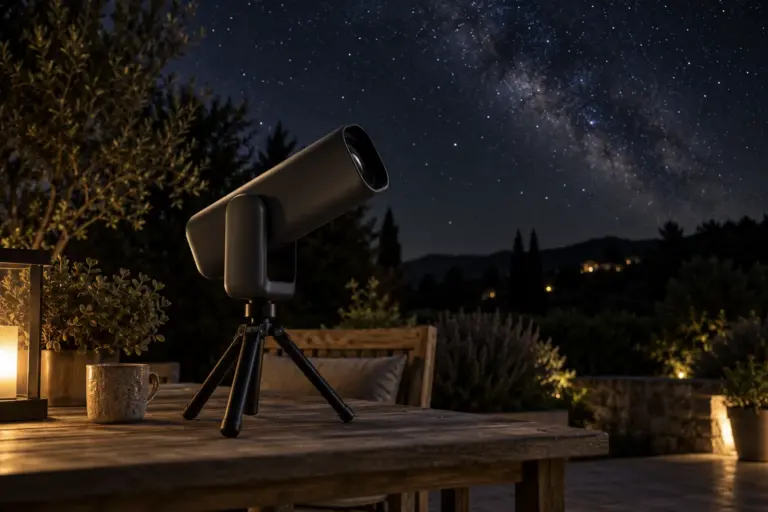
Telescope Aperture Explained: The Number That Matters
Ask a telescope box what it can do, and it will almost always answer with a magnification number. Ask an experienced observer the same question, and they’ll answer with a millimeter measurement instead. That gap is the single most useful thing a beginner can learn before spending any money.
What aperture actually is
Aperture is the diameter of the main light-gathering surface — the mirror in a reflector, the front lens in a refractor. It’s usually given in millimeters or inches: 70mm, 130mm, 8 inches (203mm). Bigger aperture means a bigger light-collecting bucket, and light is the one thing a telescope cannot manufacture on its own.
Two consequences follow directly from that. First, more aperture means fainter objects become visible — galaxies, nebulae and star clusters that simply don’t exist as anything but blank sky through a small lens. Second, more aperture means finer detail is resolvable, because resolution is also a function of the aperture’s diameter, not the eyepiece you drop in.
Why magnification numbers mislead
Magnification is a function of two focal lengths — the telescope’s and the eyepiece’s — and you can change it just by swapping an eyepiece. A manufacturer can print “up to 700x” on a 70mm telescope’s box and be arithmetically correct, while the image at that magnification is a dim, blurry smear no one would actually observe through.
In practice, the useful magnification ceiling on a good night is roughly 50x per inch of aperture (about 2x per millimeter), and atmospheric turbulence caps it well below that on most nights regardless of the telescope. A 130mm telescope tops out somewhere around 250-260x in real conditions — nowhere near what’s printed on cheaper boxes.
How aperture changes what you can actually see
| Aperture | What comes into reach |
|---|---|
| 50-70mm (binoculars, small refractors) | Moon detail, Jupiter’s moons, brighter star clusters |
| 100-130mm | Saturn’s rings clearly, Jupiter’s cloud bands, the brighter Messier objects |
| 150-200mm | Cassini’s Division in the rings under good seeing, dimmer galaxies and nebulae start showing structure |
| 250mm+ | Faint galaxy detail, planetary nebulae, a genuine step up in deep-sky richness |
These are working generalizations, not guarantees — sky darkness, seeing conditions and eyepiece quality all shift the picture. But the ranking never reverses: more aperture, more available detail, all else equal.
The trade-off nobody puts on the box
Aperture doesn’t come free. Bigger mirrors need bigger, heavier tubes, sturdier (and pricier) mounts, and longer cool-down times before the optics settle to ambient temperature and stop smearing the view. A telescope that’s technically capable of more than you’ll ever carry outside shows you less sky in practice than a smaller one you actually use. This is exactly the reasoning behind treating a Dobsonian’s aperture-to-portability ratio as the deciding factor, not the raw number on the spec sheet.
Reading a spec sheet with this in mind
- Ignore the magnification number entirely — it’s marketing, not information.
- Compare aperture first, focal length and focal ratio second (a lower f-number generally means a wider field of view, useful for star clusters and nebulae; a higher f-number suits planets and the Moon).
- Check the mount type and weight before assuming a larger aperture is the better buy for you specifically.
FAQ
Is a 60mm telescope worth buying?
For the Moon and bright planets, yes. For deep-sky objects, it’s limited — most 60mm telescopes are better thought of as a grab-and-go instrument than a primary one.
Does a bigger aperture always mean a better telescope?
Only if the mount and portability keep pace. See our full breakdown in how to choose your first telescope.
Why do two telescopes with the same aperture look different in reviews?
Optical quality, coatings, and focal ratio all vary even at a fixed aperture — aperture sets the ceiling, it doesn’t guarantee the telescope reaches it.
What aperture should a genuine beginner start with?
Something in the 100-150mm range is the sweet spot for most people: enough light grasp to be genuinely rewarding, light enough to carry outside without a fight. Full picks in our beginner telescope guide.
Next, read this
Best Telescope Under $300 and Best Telescope Under $500 both apply this aperture-first logic to real product picks.
Affiliate disclosure: AstroGear Lab is a participant in the Amazon Services LLC Associates Program. If you buy through a link on this page we may earn a small commission at no extra cost to you. As an Amazon Associate I earn from qualifying purchases. Product mentions are editorial choices, not paid placements. We do not quote prices or star ratings because both change daily — check the current listing. Read our full affiliate disclosure.